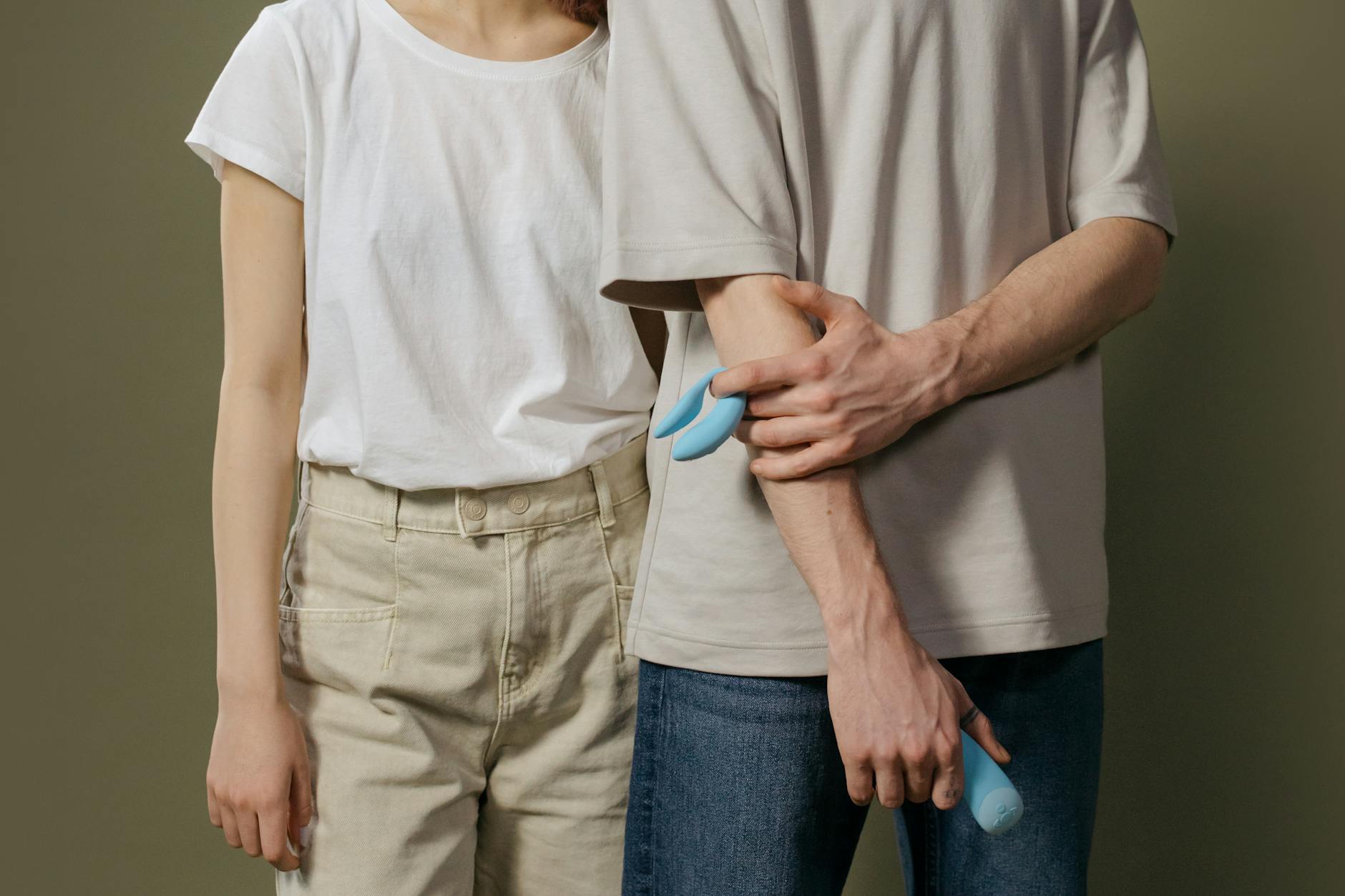
Let's talk about what nobody says out loud
Here's the thing: when partners have different bodies, they often have wildly different pleasure responses to the same touch. One person's perfect pressure is another person's "maybe a little less." One partner needs direct clitoral stimulation while the other prefers a broader stroke. And when you're trying to use your hands or a standard vibrator together, someone usually ends up compromising.
This is one of the most common friction points in couples' sex lives, and it's not actually about desire or connection. It's physics.
Why body differences create pleasure mismatches
Clitoral anatomy varies dramatically from person to person. The clitoris has an external glans (what you see) and internal structures that extend several inches into the body. The distance from the glans to these deeper nerves? That changes everything about what kind of stimulation actually registers as pleasure.
Someone with a longer internal clitoral structure might need deeper, broader pressure to feel anything at all. Someone with a more compact anatomy might find the same pressure overwhelming or even painful. These aren't preferences. They're anatomical facts.
Add in other variables: hand size (yes, it matters), finger strength, reach, how much pressure your wrist can sustain for 20+ minutes without fatigue. When partners have different body sizes and shapes, the mechanics of touch simply don't line up the way they do in movies.
The result? One of you is thinking "this feels amazing" while the other is thinking "I'm not feeling much" or worse, "this is too much." Neither of you is wrong. Your bodies just speak different languages.
Why lemon vibrators change the equation
Here's where a tool like the Lem makes sense. I'm not saying vibrators replace hands or intimacy. They don't. What they do is give both partners access to the same type of stimulation regardless of body size, hand strength, or reach.
The suction mechanism on a lemon clitoral vibrator creates consistent pressure that doesn't depend on your partner's grip strength or their arm endurance. It creates sensation in a way that a hand, no matter how much you love each other, simply can't replicate reliably. The suction concentrates stimulation on the external clitoris without requiring the kind of sustained direct friction that can become uncomfortable for some people.
For a partner with a more internal clitoral structure who was struggling to feel much from hands alone, the lemon vibrator's gentle but focused stimulation often clicks into place. For a partner who's sensitive or prefers broader sensation, starting on a lower setting gives them control without asking the other person to somehow modulate their touch to an impossible degree.
You're not replacing each other. You're removing the assumption that touch has to look the same to feel good.
The permission piece nobody talks about
Here's something I see constantly in couples therapy: when there's a pleasure gap, one partner often goes into "performance mode." They're so focused on trying to get their partner to feel something that they stop being present. They're running through techniques. They're wondering if they're doing it right. And their partner? They're feeling all that anxiety, which makes arousal even harder.
Introducing a tool like a lemon vibrator actually takes some of that pressure off the relationship itself. You're not trying to fix each other's bodies. You're just adding another option to the menu. Suddenly, you're on the same team instead of feeling like you're failing at the same thing.
Many couples I work with find that using a lemon vibrator together paradoxically makes them feel closer, not more distant. Because they're both finally having good sex. And good sex together builds actual intimacy, not just the idea of it.
Setting it up so it actually works
If you're thinking about trying this with your partner, here's what actually matters.
Start with honest conversation. Not "I want you to feel better" (which sounds like they're broken). Try: "I want us both to feel amazing at the same time. What would that look like?" This reframes it as a shared goal, not a fix.
Lose the"one person does, one person receives" assumption. Some couples use the lemon vibrator on one partner while they're together. Some take turns. Some find it's hottest when they're both involved in choosing when and how it's used. There's no script.
Manage expectations about novelty. The first time using any new tool, you might both feel a little awkward. That's normal. By the third or fourth time, it usually feels integrated instead of foreign. Give it a real shot before deciding.
Build in communication, not performance. Check in with "how does that feel?" and actually listen. Adjust pressure, positioning, timing based on what you hear. This isn't about proving anything works. It's about finding what works for both of you.
Lemon vibrators are particularly good for this because they give you feedback through sensation, not guesswork. You can see when your partner's breathing changes. You can feel them move toward or away from the sensation. You're actually in dialogue instead of hoping you're doing it right.
What to avoid
Don't introduce a tool as a solution to a disconnection problem. If you're not talking to your partner, a vibrator won't fix that. It'll just be a vibrator in an already silent room.
Don't use it as a substitute for other kinds of touch. The whole point is to add to what you already do, not replace it. Hands, mouths, bodies. The lemon vibrator is a tool you sometimes use together, not your new default.
Don't assume one setting works for both of you. Even long-term couples discover their preferences change. Temperature, fatigue, stress, cycle, mood. All of it shifts. Check in each time, not just the first time.
The bigger picture
One of the biggest myths about couples' sex is that it's supposed to feel the same for both people. It never does. You have different nervous systems, different histories, different bodies. The goal isn't sameness. It's mutual pleasure.
When partners have different body types, using tools that create consistent, adjustable stimulation isn't settling for less. It's the most honest way to say: "I want you to feel good, and I want to feel good, at the same time."
That's not transactional. That's actually the whole thing.
People also ask
Can we use a lemon vibrator if one of us is much larger or smaller than the other?
Absolutely. In fact, body size differences are exactly when a lemon vibrator becomes most useful. When there's a big reach or strength difference between partners, a tool that doesn't depend on hand size makes a real difference. A lemon clitoral vibrator creates focused stimulation that works regardless of your partner's physical dimensions.
What if my partner is nervous about using toys together?
This is really common, and it usually comes from one of two places: either they're worried it means their touch isn't enough (it doesn't), or they're anxious about novelty. Start by explaining that you want this together, not instead of them. Many couples find it helps to look at a lemon vibrator as something you both control and experience, not something one person uses on the other. Frame it as exploration, not performance.
How do we know which lemon vibrator to choose?
Start with something straightforward like the Lem. It has multiple settings so you can adjust to what feels good for both of you. Read real reviews from other couples (not just solo users). Consider whether you want something quiet, waterproof, rechargeable. Those practical things matter more than you'd think when you're actually using it together.
Should I be worried about sensitivity or numbness if we use a vibrator regularly?
Not if you're smart about it. The lemon suction mechanism is gentler than traditional vibration, which means less risk of numbing over time. That said, take breaks. Use it once or twice a week, not multiple times daily. Vary settings. Your body is smart and will tell you if something's too much. Listen to that.
What if pleasure gaps are a symptom of something bigger, like a disconnect in the relationship?
Then you need to handle that first. A tool doesn't fix a broken connection. But I also see couples where the physical disconnect has created emotional distance, and addressing the physical piece actually reopens the conversation. If you're struggling with something deeper, consider talking to a couples therapist or counselor alongside trying new approaches to pleasure. Both matter.
Does using a toy together make the experience less intimate?
For many couples, it's the opposite. When both partners are actually experiencing pleasure, when you're both present and attuned to what feels good, intimacy deepens. You're not performing. You're not wondering if it's working. You're both just there, feeling good together. That's as intimate as it gets.
The real win
I work with couples where pleasure has become a source of anxiety instead of connection. Someone's not feeling much, someone else feels too much, and both of them blame themselves. What shifts things is removing the idea that your body should magically know how to please another body that's shaped completely differently.
A lemon clitoral vibrator isn't the answer to everything. But when partners have different bodies, it's often the answer to "how do we both feel good at the same time?" And that question, answered honestly and together, changes things.
Your bodies don't have to speak the same language for pleasure to be shared. You just need a few tools that help them communicate.